
Core Literacy
Core Literacy in Detail
At Orchard Park Primary School, Core Literacy provides the essential building blocks for reading and writing.
It ensures every student develops the foundational skills needed to decode, spell and write with confidence — the skills that underpin success across all areas of learning.
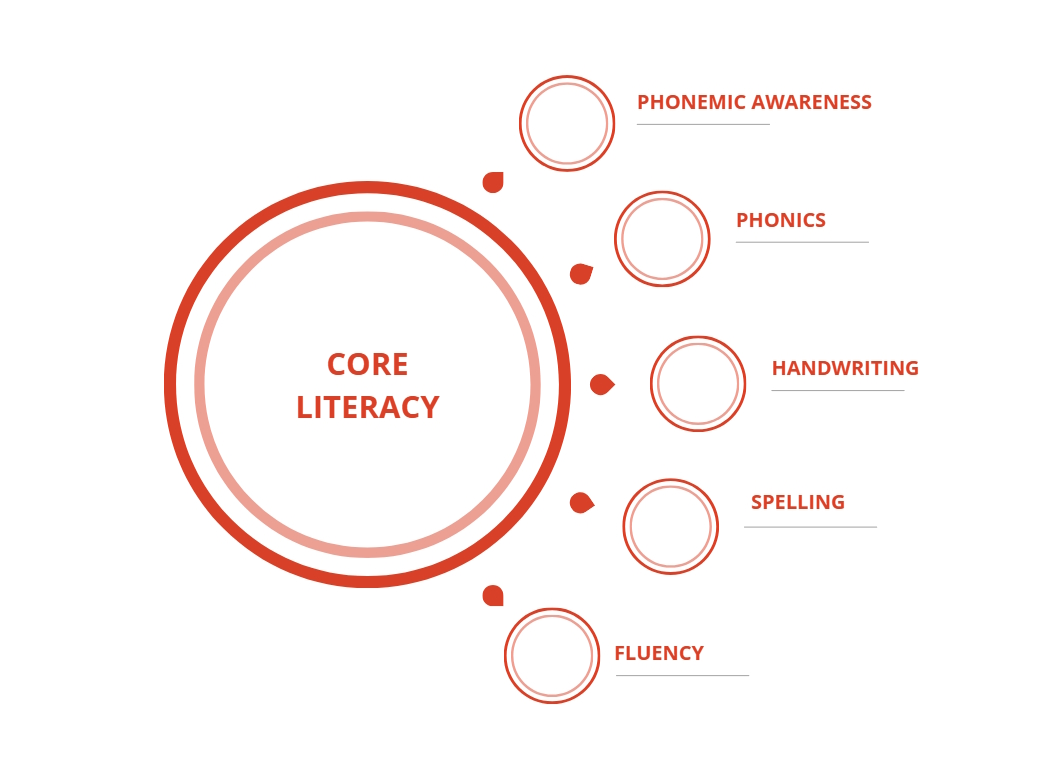
What Students Learn
Students participate in daily, structured lessons focusing on:
-
Phonemic Awareness – recognising, identifying and manipulating the smallest units of sound (phonemes) in spoken words.
This oral skill is taught before and alongside phonics, helping students hear patterns in language, break words into sounds and prepare their brains for linking sounds to letters.
For example, students learn to segment the word dog into /d/ /o/ /g/ and blend the sounds together.
Phonemic awareness is a key predictor of early reading success and is taught through short, explicit and engaging activities. -
Phonics – using a Systematic Synthetic Phonics (SSP) approach, aligned with the Victorian Department of Education’s Phonics Plus program.
This evidence-based program, used in Prep to Year 2, explicitly teaches students to match letters (graphemes) to sounds (phonemes) in a clear and sequenced way.
Children learn to blend sounds to read and segment sounds to spell.
The Phonics Plus sequence also integrates spelling, handwriting and fluency to ensure these foundational skills develop together.
Rather than memorising whole words, students build flexible decoding skills so they can confidently read and spell unfamiliar words.
For example, with only the six sounds in Set 1 (s, t, a, p, n, i), students can read and write dozens of words such as sat, tap, pin and pat. -
Fluency – reading smoothly, accurately and with expression.
Once decoding is secure, students are explicitly taught fluency through techniques such as Echo Reading, Choral Reading and Repeated Reading.
These practices help students develop phrasing, pace and prosody (the rhythm of speech), supporting comprehension and confidence.
Fluency is the vital bridge between recognising words and understanding what they mean. -
Spelling – learning how the English spelling system represents both sounds and meaning.
In Prep to Year 2, spelling is embedded within Phonics Plus, supporting the direct link between phonemes, graphemes and handwriting.
In Years 3 to 6, students expand their spelling knowledge through a word origin approach, exploring morphology (prefixes, roots and suffixes) and etymology (word origins and history).
This helps students understand spelling patterns and connections between words such as sign, signal and signature. -
Handwriting – developing fluent, legible and automatic handwriting.
Students learn correct letter formation, alignment and spacing, progressing towards joined script as fluency increases.
Automatic handwriting frees cognitive space for higher-level writing, spelling and composition.
How Core Literacy Is Taught
Each element is explicitly taught through short, focused lessons that follow a consistent structure:
-
The teacher models and explains the new skill.
-
Students practise together using guided activities.
-
Students apply the skill independently through reading, spelling or writing tasks.
Instruction moves from simple to complex, ensuring all students experience success and mastery at each stage.
Learning is cumulative — new concepts build on prior knowledge, allowing skills to become automatic over time.
What Makes Our Approach Effective
Our literacy teaching is grounded in the Science of Reading, the Simple View of Reading, and the Cognitive Science of Learning.
We have worked closely with Dr Emina McLean, whose research and professional learning have influenced our explicit instruction model and the way we teach phonics, fluency and writing.
The following evidence-based principles underpin our approach:
-
Structured, Cumulative and Sequential Instruction
Skills are introduced in a clear sequence, building knowledge systematically rather than incidentally.
This reflects research showing that cumulative practice supports long-term retention and automaticity. -
Explicit Teaching with Guided Practice
Teachers clearly model each new concept, support students through scaffolded practice, and gradually release responsibility.
This aligns with Cognitive Load Theory and the work of Rosenshine and McLean on effective explicit instruction. -
The Simple View of Reading
We recognise that reading comprehension = decoding × language comprehension.
Core Literacy builds the decoding side of the equation, while English lessons strengthen comprehension and vocabulary. -
High-Quality Review and Retrieval
We revisit skills regularly through cumulative review and retrieval practice, helping students store and retrieve knowledge from long-term memory. -
Data-Informed Instruction
Teachers use ongoing assessment and observation to identify gaps and adjust teaching, ensuring targeted support for every student.
Together, these principles create a consistent, evidence-informed approach that gives every student the knowledge, confidence and skills to read, spell and write successfully.
© Orchard Park Primary School