
Homework Approach
Homework: Supporting Your Child’s Reading
At Orchard Park Primary School, reading is the focus of homework. This decision is based on strong research showing that reading at home is the most effective and beneficial type of homework for primary students.
Research highlights:
- Traditional homework tasks have limited impact on primary-aged academic outcomes.
- Regular reading at home can improve reading comprehension by an average of six months.
- Reading together builds stronger parent–child relationships and increases parental engagement in learning.
- Children who read often at home show greater motivation and confidence in their reading.
- Developing a regular home reading routine helps establish lifelong reading habits.
We focus on phonics, fluency, and comprehension, and we encourage:
- Support with decodable readers, especially in the junior years
- Activities and ideas to build fluency through repeated and expressive reading
- Comprehension questions to help your child think and talk about what they read
Homework is about quality over quantity – not more work for students or parents. It’s a way to consolidate learning, practise skills and strategies taught at school, and build your child’s confidence through enjoyable reading time together. You are not expected to teach your child – just to support and enjoy reading with them.
How you can help at home:
- Read together every day – bedtime is a great time!
- Let your child see you reading – books, newspapers, recipes, anything.
- Talk about books – ask questions like “What do you think will happen next?” or “Who was your favourite character?”
- Encourage decoding – if stuck on a word, say “Try sounding it out” or “Can you break it into parts?”
- Praise effort – focus on how hard your child is trying, not just getting words right.
Reading together builds your child’s vocabulary, imagination, and confidence. It helps link spoken and written language – and it’s a special time to share.
Phonics
We teach reading using a structured approach called Systematic Synthetic Phonics (SSP). This evidence-based method teaches children how to match letters (graphemes) to sounds (phonemes) in a clear and sequenced way. Children learn to blend sounds to read and segment sounds to spell.
This approach helps students become confident, accurate decoders who can tackle unfamiliar words—not just memorise a list. For example, learning just 10 sounds can open up access to thousands of words.
SSP is structured, highly effective, and designed to build strong reading foundations that support everything students learn across the curriculum. Reading at home helps reinforce these skills and gives children extra opportunities to practise decoding with confidence.
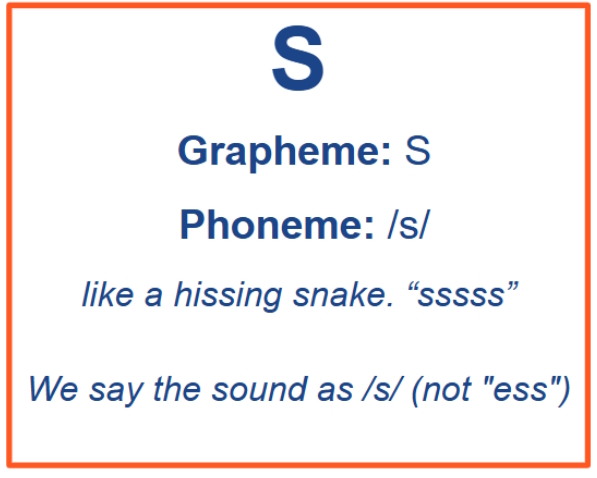
The phonics 'code' is taught in sets. Here are the first three:
- Set 1: s, t, a, p, n, i
- Set 2: m, d, g, o, c, f
- Set 3: k, e, r, u
With just the 6 phonemes from Set 1 — s, t, a, p, n, i — it's possible to create approximately 30–50 simple English words, such as it, in, sat, tap, pin, pat, and sip.
At home, you are not expected to teach this phonics code – but you can support your child by practising the sounds and words they have already learned in class. Refer to your child’s termly overview to know which sounds are being taught and when.
Simple Tips for Phonics at Home
- Read decodable readers sent home regularly – these match what your child has learned at school.
- Multiple reads of the same text help build decoding skills and reading confidence.
- Support blending: Say the sounds slowly and help your child put them together (e.g. s-a-t → sat).
- Encourage re-reading of familiar decodable texts – this builds accuracy and confidence.
- Play sound games like:
- “I Spy with my little eye something beginning with /s/”
- Clap out the sounds in a word (e.g. b/u/g)
- Find words that start or end with the same sound (e.g. bat, big)
- Use correct ‘pure’ sounds – say /m/ as mmm not muh, /t/ as t not tuh.
- Keep it short, regular, and positive – aim for around 10 minutes a day, ideally at the same time (such as before bedtime). Consistency helps build strong reading habits.
- Make it fun – phonics practice can be quick, playful and interactive.
- Refer to your child’s term overview to know which sounds they’re learning.
- Use phoneme cards or magnetic letters to build and read words (e.g. tin, pat, nap) – printable phoneme cards are available to download below.
What not to do
- Don’t encourage guessing from the first letter and the picture. For example, seeing a picture of a chair and guessing couch based on /c/ leads to incorrect habits.
- Avoid overcorrecting or making it feel like a test – the goal is confidence, not perfection.
Fluency
Fluency is the critical bridge between recognising words and understanding what they mean. Once children can confidently decode words, they begin to focus on reading sentences smoothly and with expression. This is where fluency becomes the focus.
Fluency means your child is:
- Reading accurately (not guessing)
- Reading at a good speed
- Reading with phrasing and expression
Think of it like learning the piano: A beginner must focus on each note and finger position (decoding). But after practice, they can play smoothly and focus on the melody and emotion (comprehension). Reading works the same way – once decoding is automatic, your child can concentrate on what the words mean.
Fluency is explicitly taught every day at school using proven strategies. While some parts can be practised at home, parents are not expected to teach fluency.
At school, we use:
- Echo Reading: Students listen to a model sentence from the teacher, then try to copy it with the same expression and pace.
- Choral Reading: Everyone reads together, following the teacher’s voice.
- Repeated Reading: Students re-read the same sentence or paragraph a few times, using feedback each time to read more fluently.
Fluent reading is essential for comprehension. When reading is smooth and accurate, children can understand and enjoy what they’re reading.
Simple Tips for Fluency at Home
- Fluency is not for beginners.
If your child is still learning to sound out words (decoding), the focus should stay on phonics. Fluency comes after decoding is secure. - This book is too easy!
You may hear this at home. That’s okay! Take-home readers in Prep–Year 2 are often re-read across a whole week. Early in the week, your child may need help sounding out. By the end of the week, they’re likely reading independently – this is the perfect time to focus on fluency. - What can I do at home?
You are not expected to teach fluency – but you can model and practise fluency together in fun and simple ways, especially once your child is reading full sentences: - Echo Reading: You read a sentence with great expression, phrasing and pace. Your child repeats it, trying to match how you read it.
- Choral Reading: You and your child read aloud together, keeping the same pace and tone. Note: Repeated Reading is a structured, teacher-led practice done at school and isn’t expected to be done at home.
- Interest books at home are great for this too – any favourite, well-known story can be used for Echo or Choral Reading.
- Model what good reading sounds like.
Children copy what they hear. If we model flat or rushed reading, they’re likely to copy it. Instead, show pausing at punctuation, reading with expression, and clear pronunciation.
What to not to do
- Don’t focus on fluency too early
Only practise fluency once your child is confidently decoding words. - Avoid too much pressure
Fluency tasks should feel supportive and enjoyable—not like extra work or a test. - Don’t turn practice into testing
Keep it light and encouraging. Over-correcting or timing can reduce confidence and motivation.
Comprehension
Comprehension means understanding what we read. It’s more than just reading the words correctly — it’s about making sense of them. Good readers can explain what a text is about, describe what’s happening, think about why it matters, and connect it to what they already know.
At school, we teach comprehension every day through a Read–Discuss–Vocabulary–Write lesson structure. This means we:
- Read high-quality books selected from trusted, research-informed reading lists
- Pause regularly to discuss the story using targeted questions
- Explore important vocabulary from the text
- Finish with a short written task linked to the reading and discussion
Our focus is on helping students use key comprehension strategies. These include:
- Retell (Prep to Year 2): Recounting who was in the story, what happened, and how it ended
- Summarise: Identifying and expressing the main ideas briefly
- Predict: Using clues (title, pictures, storyline) to guess what might happen next
- Question Generation: Asking questions about the text to stay engaged and deepen thinking
- Comprehension Monitoring: Checking understanding and using strategies when something doesn’t make sense
- Paraphrasing (Years 3–6): Rewording what they’ve read to show they’ve understood
To support this, we use questioning techniques to dig deeper.
Simple Tips for Comprehension at Home
Great Questions to Ask Any Reader
These three questions work with any book, and can spark deep, meaningful conversations:
- What do you think will happen next? Why?
- Can you tell me what the story is mostly about?
- Did anything confuse you while we were reading?
Follow up with:
- Why do you think that?
- Can you tell me more about that?
These can be your go-to comprehension questions — simple to ask, but incredibly powerful in helping your child think deeply and explain their ideas.
Book Chat at Home
Book chat is one of the easiest and most effective ways to support your child’s comprehension. It’s all about having conversations before, during, and after reading.
If you want to mix it up and ask a range of different questions, try:
- Look at the cover. What do you think this book might be about?
- Why might the character have done that?
- Who was your favourite character? Why?
- Can you retell the story in your own words?
- Does the main character change? How?
- What is the story’s message?
- Can you relate this story to something in real life?
- If you could change the ending, what would you do?
These questions build understanding and help your child connect with characters, events, and ideas in the text.
Comprehension Can Happen Anywhere
While it’s important to continue listening to your child read aloud throughout primary school, it's equally important that they begin to read independently as their skills grow.
You can talk about books and stories:
- Over breakfast or dinner
- While walking to or from school
- In the car
- After watching a film or show based on a book
- During quiet downtime on weekends or holidays
Any relaxed moment can become a chance to check in, ask a question, and support your child’s growth as a thoughtful, confident reader.
References and Further Reading
- Victorian Department of Education.
Literacy Teaching Toolkit: Foundation to Level 6. Victorian Literacy Portal. Retrieved June 2025.
https://www.education.vic.gov.au/Documents/school/teachers/teachingresources/discipline/english/literacy/literacy-teaching-toolkit-map-v4.pdf - Victorian Government.
How to build your child’s literacy skills: Birth to Grade 2. vic.gov.au. Retrieved June 2025.
https://www.vic.gov.au/how-build-your-childs-literacy-skills-birth-grade-2 - Victorian Government.
How to build your child’s literacy skills: Grade 3 to 6. vic.gov.au. Retrieved June 2025.
https://www.vic.gov.au/how-build-your-childs-literacy-skills-grade-3-6 - Evidence for Learning Australia.
Parental Engagement. Australasian Research Summaries, Melbourne Graduate School of Education, 2016.
https://evidenceforlearning.org.au/education-evidence/australasian-research-summaries/teaching-and-learning-toolkit/parental-engagement - Victorian Department of Education.
Homework: Policy Guidance. Policy and Advisory Library. Retrieved June 2025.
https://www2.education.vic.gov.au/pal/homework/policy - ARACY (Australian Research Alliance for Children and Youth).
Parental Engagement in Learning and Schooling: Lessons from Research. Canberra, 2012.
https://www.communityhubs.org.au/wp-content/uploads/2017/10/Parental_engagement_in_learning_and_schooling_Lessons_from_research_BUREAU_ARACY_August_2012.pdf - AITSL (Australian Institute for Teaching and School Leadership).
Strengthening Parent Engagement to Improve Student Outcomes. Retrieved 2025.
https://www.aitsl.edu.au/research/spotlights/strengthening-parent-engagement-to-improve-student-outcomes - Australia Reads.
How Parents Influence Children’s Attitudes to Reading. 2023.
https://australiareads.org.au/news/parents-influence-childrens-reading/
© Orchard Park Primary School